EF Core aggregate design for a multi-tenant SaaS app is the set of rows you must change in one transaction so a rule stays true for one tenant. The aggregate root is the only object your application service loads and saves. Tenant id is part of that boundary, not a column you remember at the end.
New to this - stay here for the model. Filters - global query filters. Tenant resolution and database layout - multi-tenancy beyond query filters. Publishing the fact - transactional outbox.
How should you design an EF Core aggregate for multi-tenant SaaS?
Search intent for ef core aggregate design multi tenant is a how-to. The reader has a shared-schema SaaS database, a few large DbSets, and bugs that look like "sometimes clinic B can attach a note to clinic A's appointment" or "the status changed but the audit row did not." They want a modeling rule that EF Core will actually enforce, not a glossary.
This page shows one aggregate, the mapping, the repository boundary, and the tenant invariants. It does not re-explain HasQueryFilter line by line, and it does not ask you to introduce a domain-event framework before you have a boundary.
When does an aggregate earn its cost?
Shared-schema SQL, EF Core 8 or later, ASP.NET Core, tenant id already resolved on the request (claim, header you validated, or a membership lookup). Database-per-tenant still wants aggregates; you just leak less across tenants if the connection itself is pinned. The design below assumes the dangerous case: one database, many tenants, global filters that a teammate can disable.
If the feature is a single table with no invariant beyond "columns are non-null," a rich aggregate is ceremony. Use it when a rule spans children: "at most 20 notes," "cannot cancel after a signed encounter," "two staff cannot both be the primary clinician."
How do you pick the boundary before the tables?
Watch: A class with public setters and a service that copies a DTO is not an aggregate. A rule that exists only in Angular will be skipped by the next client.
An aggregate is a consistency boundary. Inside it, rules are true after every save. Across aggregates, they are true eventually, via an event or a later job.
Ask:
- What must be true when this transaction commits, or the business is wrong right now?
- What can be slightly stale (a search index, an invoice total copied for reporting)?
- How big is the graph if I load it every time I touch one field?
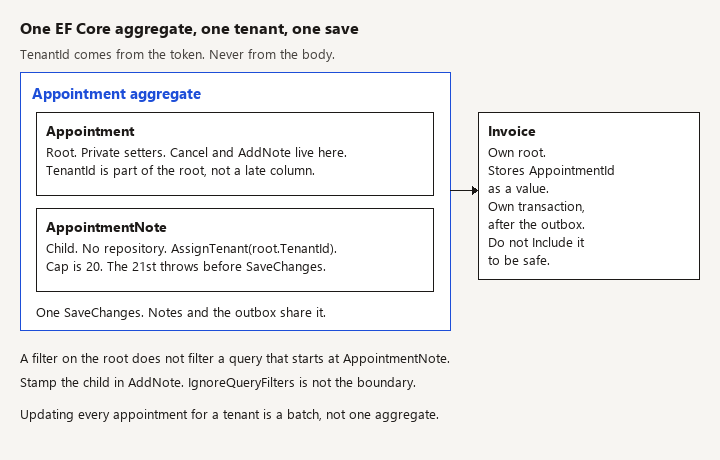
Appointment with a capped note list is one aggregate. Appointment plus every historical invoice, plus the patient demographic record, plus the clinic settings row, is a transaction you will lock and a graph you will load by accident. Patient can be its own root. Invoice can be its own root that stores AppointmentId as a value, not as a navigation you lazy-load.
Child entities do not get repositories. If AppointmentNote has INoteRepository.Get(id), callers will update the note and skip the cap, the tenant check, and the status rule that live on Appointment.
How do you model the root so callers cannot skip the rule?
Watch: Loading children by a GUID without TenantId is how another tenant's rows show up. Do not lazy-load a navigation the serializer will touch.
public sealed class Appointment
{
    private readonly List<AppointmentNote> _notes = new();

    public Guid Id { get; private set; }
    public Guid TenantId { get; private set; }
    public AppointmentStatus Status { get; private set; }
    public IReadOnlyCollection<AppointmentNote> Notes => _notes;

    public void AddNote(string text, Guid authorId)
    {
        if (Status == AppointmentStatus.Cancelled)
            throw new InvalidOperationException("Cannot note a cancelled appointment.");
        if (string.IsNullOrWhiteSpace(text))
            throw new ArgumentException("Note text is required.", nameof(text));
        if (_notes.Count >= 20)
            throw new InvalidOperationException("Note limit reached.");

        var note = AppointmentNote.Create(text.Trim(), authorId);
        note.AssignTenant(TenantId);
        _notes.Add(note);
    }

    public void Cancel()
    {
        if (Status == AppointmentStatus.Completed)
            throw new InvalidOperationException("Completed appointments stay completed.");
        Status = AppointmentStatus.Cancelled;
    }
}

public sealed class AppointmentNote
{
    public Guid Id { get; private set; }
    public Guid TenantId { get; private set; }
    public Guid AppointmentId { get; private set; }
    public string Text { get; private set; } = "";
    public Guid AuthorId { get; private set; }

    public static AppointmentNote Create(string text, Guid authorId) =>
        new()
        {
            Id = Guid.NewGuid(),
            Text = text,
            AuthorId = authorId
        };

    internal void AssignTenant(Guid tenantId) => TenantId = tenantId;
}
TenantId on the note is deliberate duplication. A filter on the root does not filter a query that starts at DbSet<AppointmentNote>. If notes are mapped as entities, stamp TenantId in the repository when the root is saved, and give notes a composite guard. Owned types avoid a second DbSet and are the better default when you never query notes without the appointment.
Private setters and a private collection stop a controller from doing appointment.Notes.Add(...). EF Core can still use the backing field. Map it explicitly so this is not folklore.
How do you map the aggregate and stamp TenantId?
public sealed class ClinicDbContext : DbContext
{
    private readonly Guid _tenantId;
    public DbSet<Appointment> Appointments => Set<Appointment>();

    public ClinicDbContext(DbContextOptions<ClinicDbContext> options, ITenantContext tenant)
        : base(options) => _tenantId = tenant.TenantId;

    protected override void OnModelCreating(ModelBuilder modelBuilder)
    {
        modelBuilder.Entity<Appointment>(b =>
        {
            b.HasKey(a => a.Id);
            b.Property(a => a.TenantId).IsRequired();
            b.Property(a => a.Status).HasConversion<string>().HasMaxLength(32);
            b.HasQueryFilter(a => a.TenantId == _tenantId);

            b.HasMany(a => a.Notes)
                .WithOne()
                .HasForeignKey(n => n.AppointmentId)
                .OnDelete(DeleteBehavior.Cascade);

            b.Navigation(a => a.Notes)
                .HasField("_notes")
                .UsePropertyAccessMode(PropertyAccessMode.Field);

            b.HasIndex(a => new { a.TenantId, a.Id }).IsUnique();
        });

        modelBuilder.Entity<AppointmentNote>(b =>
        {
            b.HasKey(n => n.Id);
            b.Property(n => n.TenantId).IsRequired();
            b.Property(n => n.Text).HasMaxLength(2000);
            b.HasQueryFilter(n => n.TenantId == _tenantId);
            b.HasIndex(n => new { n.TenantId, n.AppointmentId });
        });
    }
}
The unique index includes TenantId even though Id is a GUID. It documents the real identity in a shared database and keeps a future human-readable key honest. Do not use a unique index on Appointment.Id alone as your only tenant story; authorization still happens in the query.
The child tenant is stamped inside AddNote, not from the request body. Never accept TenantId from JSON. The claim on the request wins, and a missing appointment is a 404 so you do not reveal another tenant's id.
public async Task AddNoteAsync(Guid appointmentId, string text, Guid authorId, CancellationToken ct)
{
    var appointment = await db.Appointments
        .Include(a => a.Notes)
        .SingleOrDefaultAsync(a => a.Id == appointmentId, ct)
        ?? throw new NotFoundException();

    appointment.AddNote(text, authorId);
    await db.SaveChangesAsync(ct);
}
One SaveChangesAsync commits the appointment and its notes. Do not call SaveChanges once per note. Do not open a second DbContext to "also update the dashboard aggregate" in the same method and pretend you have one transaction. If the dashboard is another root, write an outbox record in this save and let a worker update the dashboard.
How do you change a second aggregate?
Watch: Updating every appointment for a tenant in one transaction is a batch, not one aggregate. Map rule failures to 409 or 422, and a wrong tenant to 404.
Cancelling an appointment may need to release a room hold. If both roots must change or neither must, you have drawn the boundary in the wrong place and they might be one aggregate, or you need a process manager that can compensate. If the room hold can catch up a second later, publish AppointmentCancelled in the same transaction as the cancel (outbox) and let the room aggregate handle it.
Do not Include across aggregates "to be safe." You will lock more rows than the invariant needs and you will make tenant filters look like they work while a single IgnoreQueryFilters() somewhere dumps the graph.
IgnoreQueryFilters() is a support back door. It is how a background job that "fixes notes" reads every tenant. Ban it in application code. If a worker must scan tenants, it should open a context per tenant with that tenant's id, not one context with filters off.
What changes between shared schema and database per tenant?
Database per tenant makes a missing filter less fatal because the connection points at one database. You still want aggregates: the bugs are invariant bugs, not only leak bugs. Do not stamp a random TenantId and also point at a tenant database without checking they match. A mis-routed connection plus a body-supplied id is still a leak.
Shared schema: every entity you can query needs the filter and the column. Owned collections that have no DbSet are safer than entity children. If reporting needs SQL across notes, give them the tenant column anyway and accept the entity mapping with a filter.
Migrations: a global query filter is not a constraint. Add the index and the foreign key. A filter does not stop a raw SQL report or a second app with the same login.
What fails in review?
- An "aggregate" class that is only the EF entity with public setters and a service that sets properties from the DTO. There is no invariant in code, so there is no aggregate.
- Loading children with a separate query that forgets
TenantIdbecause "the id is a GUID." Always go through the root or through a filtered set. - Lazy loading proxies on the root, so touching
Patient.Appointmentspulls another tenant's data the moment a filter is wrong, and it does it inside a serializer. - Putting
TenantIdonly on the root and then queryingAppointmentNotesin a minimal API for a grid. The grid is a second model. Build it from a query that still filters tenant, and do not let that query callAddNote. - Enforcing the 20-note rule only in Angular. The API will be called without Angular.
- A transaction that updates every appointment for a tenant "as one aggregate." That is a batch. Batches have different failure and lock behavior. Model them as a job that loads roots one at a time.
- Catching domain
InvalidOperationExceptionand returning 500. Map rule failures to 409 or 422 with a problem body. Map "wrong tenant" to 404.
How do you verify the boundary and the tenant?
- As tenant A, add notes through the API until the 21st fails with your conflict response. Confirm the database has 20 notes and all of them have tenant A's id.
- As tenant B,
GETtenant A's appointment id. Expect 404, including a direct note id if you exposed one. - In a test, call
IgnoreQueryFiltersonly to assert the back door is not used by production services (a architecture test that scans for the method name is enough). - Cancel a completed appointment. The status in SQL does not change. The rule threw before
SaveChanges. - Save one note and confirm a single transaction (SQL profiler or a test double that counts
SaveChangesAsync). An outbox row, if you write one, is in that same commit. - Run the same tests against a context constructed with tenant B's id and be sure the model filter parameter is not a stale captured tenant from a pooled
DbContext. If you pool contexts, re-set tenant per request or do not pool a context that capturedITenantContextin the constructor incorrectly. Context pooling and a scoped tenant are a known foot-gun: the pool reuses the instance. PreferAddDbContext(not pool) when the filter closes over a scoped tenant, or set the tenant id on each instance in an interceptor that reads the current request. This is the check that fails in production after you "optimize" the context.
What is this pattern not?
It is not a requirement to add MediatR, a generic repository, or a layer per noun. A root class with methods, an EF mapping, and an application method that loads one root and saves once is the whole pattern. Add events when a second root must react. Until then, a second SaveChanges on a second root inside the HTTP request is the bug you are designing away.